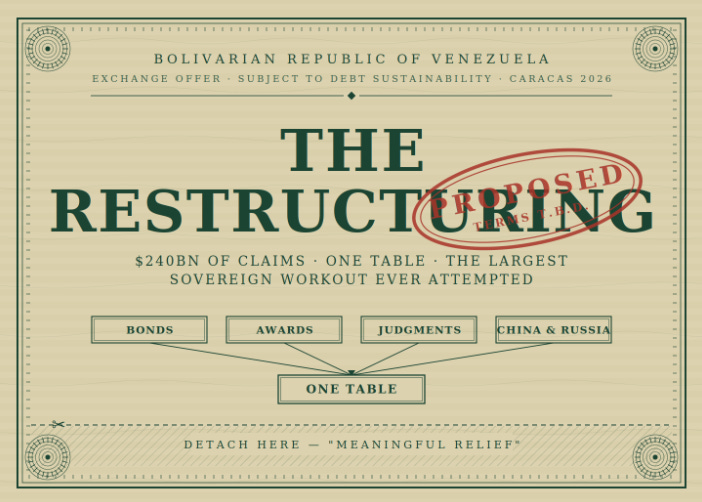

What you’re in for: Grupo Solfin made a document two weeks ago explaining their thoughts on the Venezuela situation. I’ve noted down the important stuff and here we are.
About Grupo Solfin: Grupo Solfin leads the Venezuelan investment banking / brokering side, specializing in public capital markets. Through their brokering arm ‘Casa de Bolsa’, they advise on both equity and debt issuances, often acting as lead placement agent for public offerings They also provide corporate finance, wealth management, and investment advisory services to any Venezuelan clients.
Original Document (Spanish):

Translated :
Bottom line:
2026H1 showed significant regulatory, political, and financial reconfiguration since 2017. January saw OFAC licenses, diplomatic re-openings, and legislative reforms rewriting the countries’ sovereign risk. It’s all about the markets opening up and normalising.
Grupo’s investment thesis rests on:
1) political transformation w/ the Washington court stuff and international relations
2) market transformation to attract much needed foreign investment. They need to re-open regulations for free trading so access can normalise
3) after their earthquake a month ago, which the world bank estimated to cause $19.6bn in damage, 47% of which to residential buildings and 27% infrastructure, the required reconstruction is a catalyst for a new investment cycle, the money for which they need from abroad
Timeline
Note: to avoid repeating myself and coming across as more dull than I already do - everything here was subject to license conditions. As typical in a transformative period, things have to be approved first (especially when a country is on the line), so bear that in mind.
Jan 3: Us military op + Delcy Rodriguez assuming presidency
Jan 29: National Assembly approves the reform of the Hydrocarbons Law
Jan 29 (Also): Venezuela Genera License authorising crude operations which were otherwise hindered by US sanctions, so this is seen as an effort by the US to stabilise Venezuela’s economy, so a step in the right direction for the investment thesis
Feb 3: General license 47 - diluents (what you give a substance to reduce it’s concentration, so to dilute, or strength for hte sake of making it easier to use or transport)
Feb 10: General license 48 - an OFAC license authorising certain transactions that support Venezuela’s oil and gas industry withotu having to get a license otherwise; US companies can provide them with goods and tech etc, albeit with certain conditions
Feb 10 (Also): General License 30B - 30B license authorises transactions, despite previous OFAC sanctions, that are ordinarily necessary for the operation and use of ports / airports in Venezuela and all the associated costs, including ones related to Diluents
Feb 13: GL 49 authorises US persons to negotiate and sign contingent contracts for new investments in Venezuela’s oil and gas sector.
Feb 13 (Also): GL 50 authorises certain named companies such as Shell or Chevron to conduct broader oil and gas operations in Venezuela
Feb 17: Cisneros Fund accrued $1bn with aim of rebuilding Venezuela via private equity investment, and Venezuela has it’s first ETF
March 6: GL 51 - certain transactions involving state-owned entities on the Venezuelan side can take place, and we saw the first $100mn shipment
March 13: GL 46B/48A/49A - order extends to petrochem, fertilisers, and the electricity sector
March 18: GL52 - the full operational opening of PDVSA
March 18 (Also): Cabinet reshuffle with 14 ministries and Padrino Lopez making an exit
March 19: GL 5V - authorised the sale or transfer of the PDVSA 2002 8.5% bonds
March 20: the IMF began talks with Venezuelan authorities to get a grasp on the economy’s situation and agree statistics and how a future relationship would work
March 24: GL 53 - authorising the transaction of goods / services to Venezuelan diplomatic missions, e.g. rent or official expenses
March 27: GL51A - authorises the purcahse, sale, transport, storage, and marketing of those minerals
GL54 - allows US persons to provide goods, tech, and services for any Venezuelan mineral operations
GL 55 - allows US persons to negotiate / enter into contingent contracts for future investment in Venezuela’s mineral sector
March 30: US-Venezuela embassies reopen + IBC (Indice Bursatil de Caracas; stock exchange index) hits an all time high
April 1: US removed Delcy Rodriguez from the SDN list (specially designated nationals and blocked persons, maintained by OFAC)
April 9: Mining law approved
April 14: GL 57 - financial services available with BCV and public banks
April 16: IMF and World Bank restore relations with Venezuela after 7 years; Luis Perez appointed new BCV President
April 30: Record Oil Exports and comprehensive minimum income rose to US$240
May 5: GL 58 - authorises debt restructuring
May 7: electricity demand at 9 year peak
May 8: IBC pulls back 18%
May 14: US engages with the National Electric system (Venezuela’s national power grid) in efforts for rehabilitation
May 26: BDV sins correspondent agreement with Abanca (Europe) and Banesco USA
May 28: Centerview Partners appointed as the debt restructuring advisor
June 2: National Assembly approved Electricity Service Law
June 2 (Also): Hogan Lovells was appointed as the legal advisor on Venezuela’s sovereign debt
June 10: OFAC renewed those GLs
June 23: the IBC closed at 5727 just pre-earthquake the next day
June 24: The earthquake, and along with it $6.7bn of damage (about 6% of GDP)
June 26: General License 60 - relief transactions enabled until October 23rd, so international aid to help rebuild things - US incentive is to help them rebuild by giving them money they don’t have so they don’t have to take out more debt and fill the restructuring
June 30: the BVC central bank reopens, and the official FX closed below the parallel rate, insinuating international activity, which we already know was happening, but good to have confirmation
The earthquake
The most severe in over a century, $6-10bn cost excluding public infra / reconstruction; good international response - more than 2700 specialists from over twenty countries deploying rescue and med support teams. The US committed $150mn, but this still all leaves out the reconstruction needed, mostly for ports and roads etc.
Sovereign risk
Country risk sits at a low of the last few years following the regulatory opening back in Q1, but as far as sovereign bond prices go it’s really about whether the restructuring will continue with or without the help of the IMF, especially considering the post-earthquake spending requirements. Bottom line, The IMF help would help speed things up.
Debt Restructuring
The question is really whether the restructuring plans can be backed by a Debt Sustainability Analysis - if foregone, the lack of official data this would make things more uncertain, probably lowering the probability foreign investors would allocate. The debt sustainability analysis also has to be credible, obviously, otherwise the plan doesn’t mean much - investors care about the expected value of the change, and if the data is incredulous, especially in a market ripe with other special situation alternatives, they will pass.
Inflation
I think this says it all…
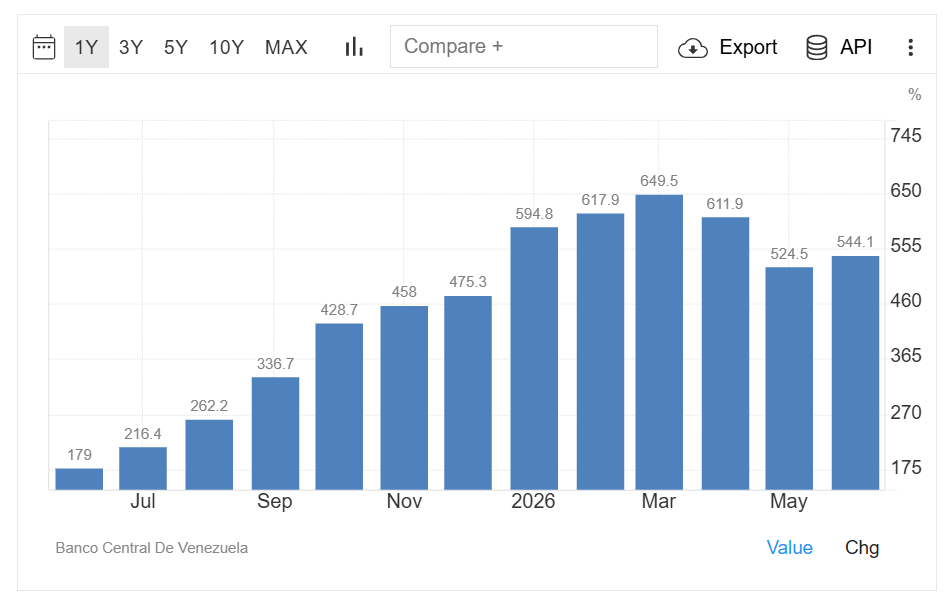
Credit: Trading Economics
So, yes, it’s trending down, but with the required reconstruction spending from the June 24th Earthquake, that may not continue. However, I’m no economist.
FX
The gap between official and parallel is closing from 40.4% at beginning of year to 17% end of last month
International reserves
$13.9bn from $11.9bn in the first half of last year - reserve requiremets remain unchanged so credit activity was limited, but banking normalisation was seen more in the second half of last year, possibly depending on the credit problem
Oil and Gas
1-1.2m barrels per day at an average price of $72.8/barrel, and the regulatory opening for Chevron and Shell etc allowed those foreign companies to take advantage - use their relative wealth v Venezuela to their advantage - there was also the new royalty and tax regime
Stock Exchange (‘Caracas’)
IBC rises 175% first half of this year in Bolivar, and 31% in USD; index didn’t react that much to the earthquake
Moving forward
The last six months, so H1 of this year, has been the fastest regulatory opening of the decade, with OFAC licenses, diplomatic reopenings, legislative reform, etc - the risk profile has changed, but on the downside it’s shown the limits of a normalisation, so the limits need to be turned into growth catalysts by:
Easing reserve requirements without compromising monetary stability,
Closing the FX gap between official and parallel,
Getting the electricity grid back and running, and
Getting the MoU agreement terms improved in the resource / industrial industry - what’s been the main problem here.
Naturally, the market focus is now with reconstruction after the earthquake - things kind of slow down until that’s taken care of, so annualised returns have been hurt but you couldn’t have predicted it, so certain things are going to need to be prioritised. This holds especially true with oil, which is the crux of all this.
Bottom line: positive growth is expected after all this plays out, depending on when credit / electricity / FX / external financing / institutional capacity to convert reconstruction into productive investment is taken care of
Catalyst for the rest of this year (H2)
Reserve requirements: banks are advancing on relations, but it’s just the credit side that’s not going far, but we have to look out for the BCV easing / real growth of the loan portfolios the banks and private credit guys have
The FX gap: the gap closed to 17.7% after FX intervention, but we need to see how the spread is when the excessive currency sales have stopped
Electricity: they need to effectively recovery power and execute their investment wisely
Debt: the restructuring will continue to move, and hopefully the IMF will help establish a framework to help, but bottom line we need to look for the debt sustainability analysis they do and how fast these creditor negotiations take place to resolve the credit issues
Reconstruction: We need to look out for a post-earthquake plan, financing, and execution of critical infrastructure
Oil and Gas: this is the only area really without any real damage after the quake, and with the new royalty regime, but to see how things are moving we need to look for oil and gas production, exports, and the application of this new fiscal regime
If looking to allocate, I can connect you
Venezuela is a closed market, especially on the Caracas equities side. The bonds are traded OTC, but the same problem exists. You need to either be registered as a national with a local bank account + Gov ID etc, or use a fund who has those connections to the brokering houses there. Personally I think the latter is much easier. I’ve been exploring the space and have come across a few interesting funds, and am happy to make the intro.